Precision Sulfuric Acid Anodizing (Type II & III) for industrial applications. Durable, corrosion-resistant finishing in clear and color.
Sulfuric Acid Anodizing
- Architectural
- Automotive
- Electronics
- Sporting Goods
- Adhesion
- Aesthetics
- Corrosion Resistance
- Dielectric Properties
- Heat Dissipation
- Wear Resistance
- Aluminum Alloy
- Aluminum Casting
- Aluminum Forging
Key Advantages: Aesthetics and Durability
-
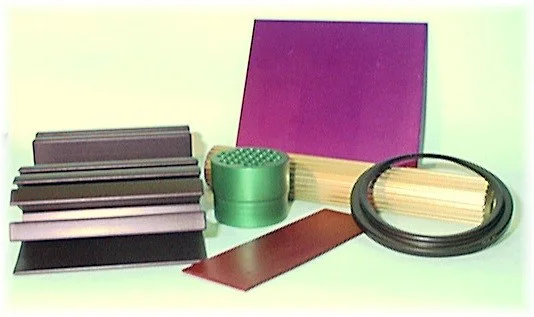
Vibrant Coloring: The porous structure of the “fresh” oxide layer acts like a sponge. It can be dyed almost any color—black, red, blue, gold, or green—before being sealed.
-
Corrosion Resistance: The aluminum oxide layer is naturally much more resistant to salt spray and atmospheric corrosion than raw aluminum.
-
Surface Hardness: The coating is significantly harder than the base metal, providing moderate protection against light scratches and abrasions.
-
Cost Efficiency: Compared to Chromic or Hardcoat anodizing, Sulfuric Type II is faster and uses less expensive chemicals, making it the most economical choice for large production runs.
The Role of Supplemental Coatings
Anodizing is not complete until the pores are “closed.” Without sealing, the coating will absorb oils and stains.
-
Hot Water Seal: The most common method; it hydrates the oxide to swell the pores shut.
-
Nickel Acetate Seal: The industry standard for dyed parts, as it “locks” the dye molecules into the pores to prevent fading.
-
Sodium Dichromate Seal: Results in a yellowish-green tint; used strictly for maximum corrosion resistance in industrial or military settings.
-
Teflon (PTFE) Impregnation: Occasionally used to add “dry” lubricity to the surface.
Specifications
|
Specification
|
Comments
|
|---|---|
|
MIL-A-8625F
|
.000070 – .001
|
|
Type II
|
Use on all aluminum alloys, but do not use where solution will become entrapped.
|
|
Type IIB
|
Light coating
|
|
Class 1
|
Non-dyed (Clear)
|
|
Class 2
|
Dyed
|
We offer 3 types of Anodized Plating. Click the buttons below to see more details on each type:
Industry Applications
Sulfuric Anodizing is the standard finish for consumer goods and general engineering:
Consumer Electronics: Smart-phone housings, laptop cases, and tablet bodies.
Automotive: Interior trim, roof racks, and engine dress-up kits.
Sporting Goods: Flashlight bodies, carabiners, and bicycle components.
Architectural: Window frames, railings, and storefront extrusions (often using “Clear” Type II).
Finish Comparison
|
|
Sulfuric (Type II)
|
Chem Film
|
Hardcoat (Type III)
|
|---|---|---|---|
|
Coating Type
|
Anodic (Insulative)
|
Conversion (Conductive)
|
Anodic (Insulative)
|
|
Thickness
|
Moderate (Up to 0.001")
|
Negligible
|
Heavy (Up to 0.003")
|
|
Color Options
|
Unlimited (Dyeable)
|
Clear or Gold only
|
Dark/Black (Hard to dye)
|
|
Hardness
|
Moderate
|
Low
|
Very High
|
|
Dimensional Change
|
Significant (Build-up)
|
None
|
Most Significant
|
|
Sulfuric (Type II)
|
|
|---|---|
|
Coating Type
|
Anodic (Insulative)
|
|
Thickness
|
Moderate (Up to 0.001")
|
|
Color Options
|
Unlimited (Dyeable)
|
|
Hardness
|
Moderate
|
|
Dimensional Change
|
Significant (Build-up)
|
|
Chem Film
|
|
|---|---|
|
Coating Type
|
Conversion (Conductive)
|
|
Thickness
|
Negligible
|
|
Color Options
|
Clear or Gold only
|
|
Hardness
|
Low
|
|
Dimensional Change
|
None
|
|
Hardcoat (Type III)
|
|
|---|---|
|
Coating Type
|
Anodic (Insulative)
|
|
Thickness
|
Heavy (Up to 0.003")
|
|
Color Options
|
Dark/Black (Hard to dye)
|
|
Hardness
|
Very High
|
|
Dimensional Change
|
Most Significant
|
Why Choose One Over the Other?
Chem Film (Alodine):
The “Electrical” Choice
As you noted with high-precision components, Chem Film (Chemical Conversion Coating) is the primary choice when you need to protect aluminum but must maintain electrical conductivity. Unlike the anodizing processes, Chem Film is not an insulator. It adds negligible thickness to the part (less than 1 micron), so it won’t interfere with tight-fitting threads or precision bore diameters. It is also the “Value” choice because it doesn’t require electricity to apply.
Best for: Electronics housings that require EMI/RFI shielding, heat sinks, and grounding points.
Sulfuric Anodize (Type II):
The “Aesthetic” Choice
Type II is the most common form of anodizing. It creates a porous oxide layer that is much thicker than Chem Film (typically 5 to 25 microns) but thinner than Hardcoat. This porosity is its greatest strength: it acts like a sponge, allowing the part to be dyed in vibrant colors like red, blue, or gold. Once the pores are “sealed” in a boiling bath, the finish becomes highly corrosion-resistant and provides moderate scratch protection.
Best for: Consumer electronics (laptops/phones), automotive trim, sporting goods, and decorative architectural hardware.
Hardcoat (Type III):
The “Industrial” Choice
Hardcoat is the “Armor” choice for the most demanding environments. It is processed in a sulfuric acid bath like Type II, but at much lower temperatures and higher voltages. This creates a very dense, ceramic-like skin that is exceptionally thick (up to 100 microns). It is so hard that it can only be removed by grinding. Because the coating is so dense, it is an excellent electrical insulator and is typically dark gray or black, making it poor for decorative coloring.
Best for: Hydraulic cylinders, firearm receivers, high-wear gears, and any part subjected to heavy abrasion or salt-water exposure.
A Note on "Dimensional Build-up"
When specifying Type II Anodizing, you must account for dimensional growth. Unlike Black Oxide, which has no thickness, Anodizing typically grows “out” by 50% of the total coating thickness. If you specify a 0.0006” coating, your part’s diameter will increase by 0.0006” (because 0.0003” is added to each side). This is critical for precision-fit holes and threads.